Implant Bridge in Evanston, IL
Lose several neighboring teeth and an implant-supported bridge is one way to bring back your smile, your bite, and your confidence. Where a traditional bridge leans on the adjacent teeth for support, an implant bridge anchors directly to your jawbone, which helps preserve bone, protects the surrounding teeth, and gives you a fixed, natural-looking result. If you're only missing a single tooth instead, a standalone implant may be the simpler option. At Way Dental, Dr. Andre Amarante designs a custom treatment plan to replace your missing teeth and restore full function.
What it is
A fixed bridge held by two or more dental implants instead of natural teeth, replacing three or more missing teeth in a row as one permanent, non-removable restoration.
Who it's for
Patients missing several teeth in a row who want a permanent, stable solution that preserves bone and leaves the healthy adjacent teeth alone.
How we help
Precise digital imaging pinpoints optimal implant placement, then we craft a bridge to match your natural teeth and tailor the treatment plan to your specific situation.
Missing teeth shouldn't hold you back. An implant bridge restores your smile permanently.
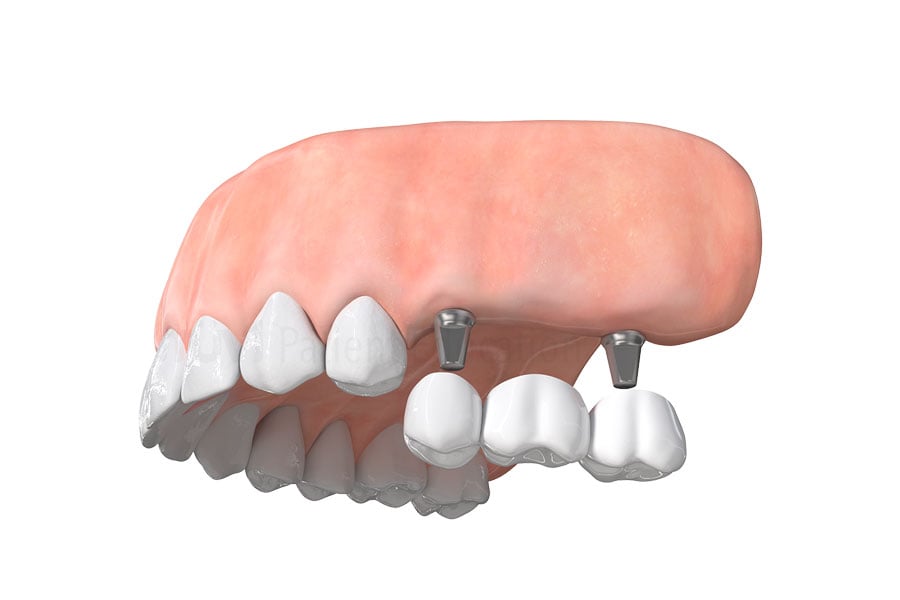
How an Implant Bridge Works
- Two or more titanium implants go into the jawbone to act as anchors
- A custom bridge of connected porcelain crowns fastens onto those implants
- That single, fixed restoration replaces three or more missing teeth at once
- Unlike traditional bridges, no healthy teeth need to be filed down or crowned
- By stimulating the jawbone, the implants head off the bone loss that follows missing teeth
- The finished result looks, feels, and functions like your natural teeth

Why Replace Missing Teeth Now?
- Bone loss accelerates: With no tooth roots in place, the jawbone starts to resorb and shrink quickly
- Teeth shift: Neighboring teeth drift into the open spaces, throwing off alignment and your bite
- Remaining teeth are at risk: The teeth picking up the slack take on extra stress and can be lost too
- Chewing becomes difficult: Gaps limit the range of foods you can comfortably eat
- Facial changes: As bone melts away, the jaw area can take on a sunken, aged look
- Act sooner and treatment stays simpler, with flexible financing options available
Advantages of an Implant Bridge
- Beautiful, natural appearance: Porcelain crowns custom-crafted to match your existing teeth exactly
- Eat any food: Because implant bridges are permanently fixed, you eat, bite, and chew with full confidence
- No shifting or moving: Anchored right to the jawbone for rock-solid stability
- Preserves bone: By stimulating the jawbone, the implants prevent the deterioration that follows tooth loss
- Protects adjacent teeth: Unlike traditional bridges, there's no grinding down of the healthy neighbors
- Long-lasting: Cared for properly, implant bridges can last decades
The Treatment Process
- Consultation: Dr. Andre Amarante assesses your teeth and jawbone with digital X-rays and CT scans
- Treatment plan: Your personalized plan is shaped around how many teeth are missing and how much bone is available
- Implant placement: Titanium posts are surgically set into the jawbone under local anesthesia
- Healing period: Over 3–6 months, the implants fuse with the bone through osseointegration
- Bridge fabrication: Custom porcelain crowns are designed and joined to form your bridge
- Final placement: The bridge is permanently attached to the implants, and your new teeth are complete
An implant bridge fills the gap without compromising your healthy teeth. Schedule a consultation today.
What to Expect at Your Visit
Visit Steps
- Evaluation: Dr. Andre Amarante examines your mouth, goes over your imaging, and talks through your goals and options
- Custom plan: You get a detailed treatment plan covering timeline, cost, and what to expect at each stage
- Surgery: Implants are placed in a comfortable office setting, with inhaled sedation (nitrous oxide) available
- Progress checks: Regular follow-up visits keep an eye on healing and make sure everything is on track
- Final restoration: Once you've healed, your custom bridge is permanently attached
Helpful Tips
- If additional bone support is needed, we'll plan and coordinate your care before implant placement
- Follow every post-surgical instruction closely to support healing
- Keep to soft foods for the first few days after implant surgery
- Brush and floss around the implant bridge daily to keep your oral hygiene excellent
- Come to all of your scheduled follow-up appointments
- Cared for well, your implant bridge can last for many years
Frequently Asked Questions
Two implants can usually support a bridge that replaces three to four teeth, and longer spans may need a few more to distribute the biting force evenly. The exact count depends on the strength and spacing of the implants relative to the gap they're bridging.
Dr. Andre Amarante settles on the ideal number based on your jawbone density, where the missing teeth are, and how many are being replaced. Digital imaging at your consultation shows exactly how much bone you have to work with, which helps determine both implant placement and the final design of your bridge.
They offer different advantages. An implant bridge spares your healthy adjacent teeth from being ground down, helps preserve jawbone through stimulation, and is supported by the implants themselves rather than by neighboring teeth, so its durability doesn't hinge on the health of those teeth. How long it lasts varies with the restoration, your oral hygiene, bite forces, and how well you keep up with maintenance.
A traditional bridge leans on the neighboring teeth for support, which can weaken them over time and puts you at risk of losing the whole bridge if one of those anchor teeth fails. There's also no way for a traditional bridge to stop the bone loss that follows tooth loss, since nothing is stimulating the jaw underneath it.
That said, a traditional bridge can still be the right call in certain situations, particularly when the neighboring teeth already need crowns for other reasons. Dr. Andre Amarante will walk you through both options so you can weigh cost, timeline, and long-term outcomes for your specific case.
From the first implant placement to the final bridge, expect roughly 4 to 8 months, most of it healing while the implants fuse with the jawbone through osseointegration. Placement itself happens in a single visit, but the bone needs time to bond solidly with the implants before they can safely carry a bridge.
Once healing is confirmed, your custom bridge is designed, fabricated, and permanently attached, which typically adds a few more weeks. If additional bone support is needed first, the overall timeline runs longer before implant placement, since the graft site has its own healing period to complete.
Every case is different, and Dr. Andre Amarante will map out a specific timeline for you at your consultation at our Evanston, IL office, based on how many teeth you're replacing and your bone density.
Dr. Andre Amarante checks your bone density at the consultation using digital X-rays and CT imaging, so you'll know exactly where you stand before any treatment begins. Bone loss is common after teeth have been missing for a while, and it's a routine part of planning, not a reason to rule out an implant bridge.
If additional bone support is needed, we'll plan and coordinate your care to give the implants a solid foundation. That adds time to your overall treatment, but it sets your bridge up to last for the long run.
In some cases, strategic implant placement can work with the bone you already have, angling or positioning the implants to make the most of the density that's present. Your treatment plan will reflect whichever approach gives you the most stable, long-lasting result.
The price shifts with how many implants you need, whether any additional bone support is needed, and how complex the bridge is. Replacing three teeth with two implants generally costs less than a longer span that needs additional implants for support.
You'll get a detailed estimate at your consultation, once Dr. Andre Amarante has reviewed your imaging and mapped out exactly what your case requires. It's also worth factoring in long-term value: unlike a traditional bridge, an implant bridge doesn't rely on neighboring teeth for support, which is a large part of why patients often choose it, though longevity varies with the restoration, your oral hygiene, bite forces, and how well you keep up with maintenance.
We offer flexible financing options to keep treatment affordable, so cost doesn't have to stand between you and a permanent solution.
Treat your implant bridge like natural teeth, with a few extra habits built in to protect the implants underneath. Here's what a good care routine looks like:
- Brush twice daily, angling the brush to clean along the gumline where the bridge meets your gums
- Floss daily, including under the bridge, using a floss threader or water flosser to reach spots a regular floss pass will miss
- Avoid using your bridge to bite down on very hard foods like ice or hard candy
- Keep up with regular checkups and cleanings so we can monitor the implants and catch any issues early
With proper maintenance, implant bridges can last for decades, and the daily care involved is honestly not much different from caring for your natural teeth.
Bring back your smile and your confidence. Schedule your implant bridge consultation today.