Oral Surgery in Evanston, IL
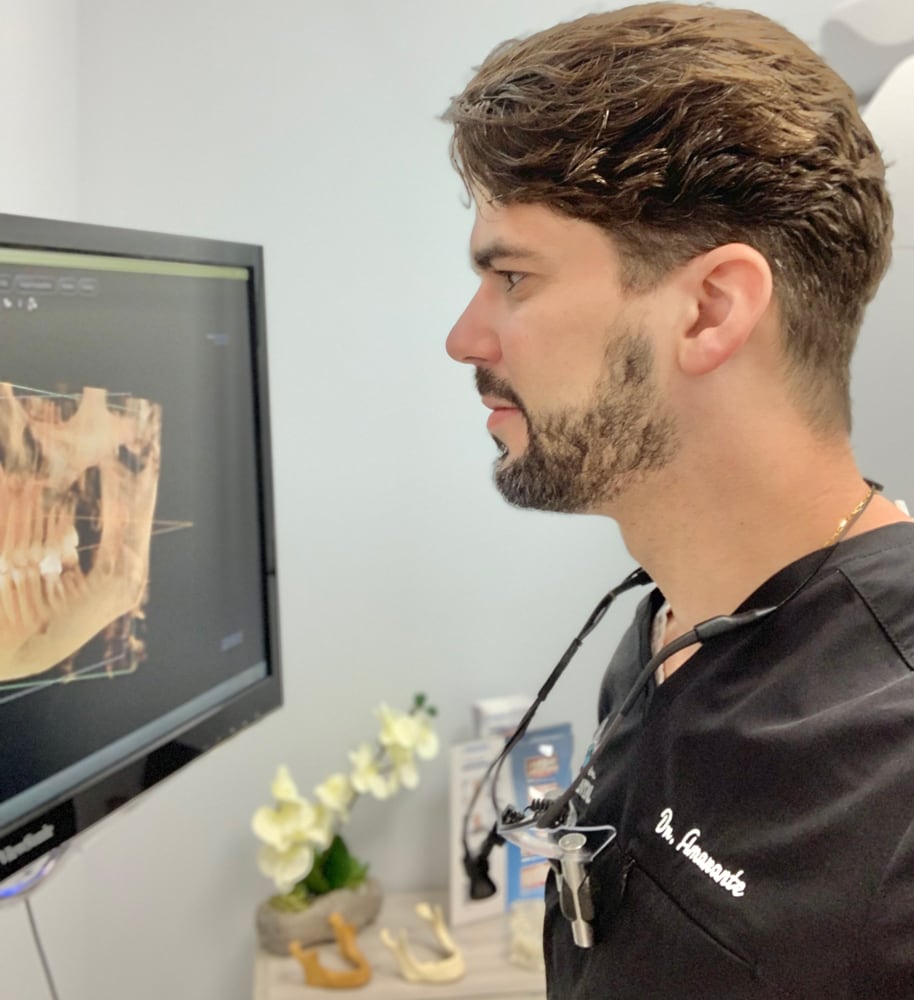
Needing oral surgery rarely means a referral to a stranger across town anymore. From wisdom tooth removal to dental implant placement, Dr. Andre Amarante performs a broad range of surgical procedures right here at Way Dental in our Evanston office. Because Dr. Amarante completed dental school twice and earned an oral surgery certificate before his DDS, he pairs a deep foundation in general dentistry with the surgical skill to handle complex cases comfortably.
Surgery in one place
Wisdom teeth, extractions, and implant placement all handled in-house, so there's no separate referral and the dentist doing the work already knows your smile.
Trained twice over
A Fellow of the International Association of Oral & Maxillofacial Surgeons (IAOMS) and an active member of ALACIBU, Dr. Amarante earned an oral surgery certificate in Brazil and a DDS from NYU.
Comfort first
A gentle, conservative approach, backed by local anesthesia and calming nitrous oxide, keeps even anxious patients at ease through surgical care.
Not sure whether a tooth can be saved or is better replaced? Schedule a consultation and we'll walk you through your options.
Wisdom Tooth Extraction
More often than not, wisdom teeth arrive without enough room to come in properly. Pushing against their neighbors, they crowd and shift nearby teeth, and that pressure can escalate to cavities and bone resorption in adjacent teeth. Left in place, an impacted or infected wisdom tooth can even form a fluid-filled cyst that damages the jawbone, nearby nerves, and surrounding teeth.
Taking problematic wisdom teeth out early, ideally before the roots are fully formed, shortens recovery and protects the rest of your smile. Dr. Andre Amarante will review your X-rays and let you know whether removal is recommended.
Learn more about wisdom tooth extractionWhy timing matters
- Removal is easier and healing faster while roots are still developing
- Keeps neighboring teeth from crowding and shifting
- Sidesteps cavities and bone loss caused by hard-to-clean angles
- Heads off infection, pain, and cyst formation
Replacing Missing Teeth with Dental Implants
For replacing missing teeth, dental implants are the gold standard. Instead of resting on top of the gums, an implant takes the place of the tooth root itself, stimulating the jawbone, preventing the bone loss that follows tooth loss, and protecting the health of the teeth around it. Missing one tooth, several, or all of them, you'll find an implant-based solution designed to last.
Wondering which tooth-replacement option fits your situation? We'll help you compare them at your visit.
Find the Right Tooth-Replacement Option
Missing One Tooth
- One implant restores both the visible tooth and its root
- Keeps the underlying bone strong and healthy by stimulating it
- Spares neighboring teeth from being ground down for a bridge
- Learn more about replacing one tooth
Missing Multiple Teeth
- With several teeth gone, the bone resorbs and shrinks quickly
- Remaining teeth begin to drift and shift into the open space
- Implant-supported solutions halt the cascade of further tooth loss
- Learn more about replacing multiple teeth
Missing All Your Teeth
- One implant-supported full bridge or denture replaces an entire arch
- Brings back the lost roots, not just the visible teeth
- Delivers far more stability and function than traditional dentures
- Learn more about full-arch replacement
Frequently Asked Questions
Usually not. Dr. Andre Amarante handles wisdom tooth removal, extractions, and dental implant placement right in our Evanston office, so your surgical care stays with the dentist who already knows your history. Keeping treatment in-house means fewer appointments, no repeating your history to a new provider, and a treatment plan that stays consistent from your first consultation through healing.
On the rare occasion a highly specialized case calls for an outside specialist, we'll coordinate that referral for you. Outside of those rare exceptions, wisdom tooth extraction, routine tooth extractions, and dental implant placement all fall well within the scope of care we provide, so most patients can plan on completing their entire treatment journey with the same familiar team.
Local anesthesia numbs the area during surgery, and for patients who'd rather feel more relaxed we also offer inhaled sedation (nitrous oxide). Tell us if anything feels sharp and we will pause and add more anesthetic. You'll head home with clear instructions to keep recovery smooth. Learn more about our inhaled sedation.
Once the numbness wears off, it's normal to notice some soreness as your body begins to heal. That discomfort is manageable with over-the-counter or prescribed pain medication, and it tends to ease noticeably within the first few days. We'll walk you through exactly what to expect before you leave our office, so nothing during recovery catches you off guard.
Among tooth-replacement options, only implants replace the root of the tooth. That root stimulates the jawbone and prevents the bone loss that normally follows missing teeth, all while leaving neighboring teeth untouched. What you get looks, feels, and functions like a natural tooth, and it's built to last.
A bridge, by contrast, requires grinding down the healthy teeth on either side of the gap to anchor a replacement, and a removable denture rests on top of the gums without stimulating the bone underneath at all. Over time, that unsupported bone can shrink, changing the fit of the denture and the shape of the face. An implant sidesteps both problems by replacing what's actually missing, the root, not just the visible tooth.
Whether you're missing one tooth, several, or all of them, an implant-based solution can be built around your situation, giving you a foundation that's meant to last rather than one you'll need to adjust or replace every few years.
Within a few days, most patients feel substantially better. The first day or so calls for the most care, but as swelling and tenderness ease, most people are back to their normal routine faster than they expected.
- Rest and take it easy, especially for the first 24 hours
- Stick to soft foods while the extraction site is tender
- Care for the site gently, avoiding vigorous rinsing, spitting, or touching the area
Sticking to your post-operative instructions keeps healing on track, and we'll check in and stay available if you have questions during recovery. If anything feels off, whether that's unusual pain, swelling, or bleeding, reach out and we'll get you the guidance you need.
Cost depends on the specific procedure, whether that's a straightforward extraction, an impacted wisdom tooth, or dental implant placement, and on whether inhaled sedation is part of your visit. Because every case is different, we review your X-rays and treatment plan first, then provide a clear, itemized estimate before anything is scheduled, so there are no surprises later.
Most dental insurance plans cover a portion of oral surgery, and our team is happy to help you understand your benefits ahead of time. For anything insurance doesn't cover, we also offer financing options so cost doesn't have to stand between you and the care you need.
Dr. Andre Amarante's path to oral surgery started with dental school twice. After earning an oral and maxillofacial surgery certificate through a residency program in Brazil (OSID/UFBA), he completed a Doctor of Dental Surgery (DDS) at New York University College of Dentistry. That combination gives him a general dentist's full foundation plus focused surgical training that most general dentists don't pursue.
He is also a Fellow of the International Association of Oral and Maxillofacial Surgeons (IAOMS) and an active member of ALACIBU (Asociación Latinoamericana de Cirugía y Traumatología Bucomaxilofacial, the Latin American Association of Oral and Maxillofacial Surgery), professional associations that keep him connected to current techniques and standards in the field. At Way Dental, that training translates into a broad spectrum general dentist with an emphasis in Cosmetic Dentistry and Oral Surgery, not a separate specialty practice, so the same dentist who already knows your smile can also handle procedures many general practices refer out.
For the rare case that truly calls for an outside specialist, we say so upfront and coordinate that referral for you.
Most adults missing one or more teeth are good candidates for dental implants, as long as there's enough healthy jawbone to support them and any gum disease is under control. Age alone isn't a barrier. What matters more is the health of the bone and tissue where the implant will sit, which is exactly what Dr. Andre Amarante evaluates with a clinical exam and imaging before recommending treatment.
If bone density has diminished from long-term tooth loss, that doesn't rule implants out. In many cases, additional bone support can be planned and coordinated as part of your treatment, building a stable foundation before the implant itself is placed. Certain health conditions or habits, like uncontrolled diabetes or heavy smoking, can affect healing and are worth discussing openly at your consultation.
The best way to know for certain is a consultation, where Dr. Andre Amarante reviews your dental and health history alongside your X-rays and walks you through whether implants make sense for replacing one tooth, several, or an entire arch.
Comfortable, in-house oral surgery is closer than you think. Call our Evanston office to book your consultation.